
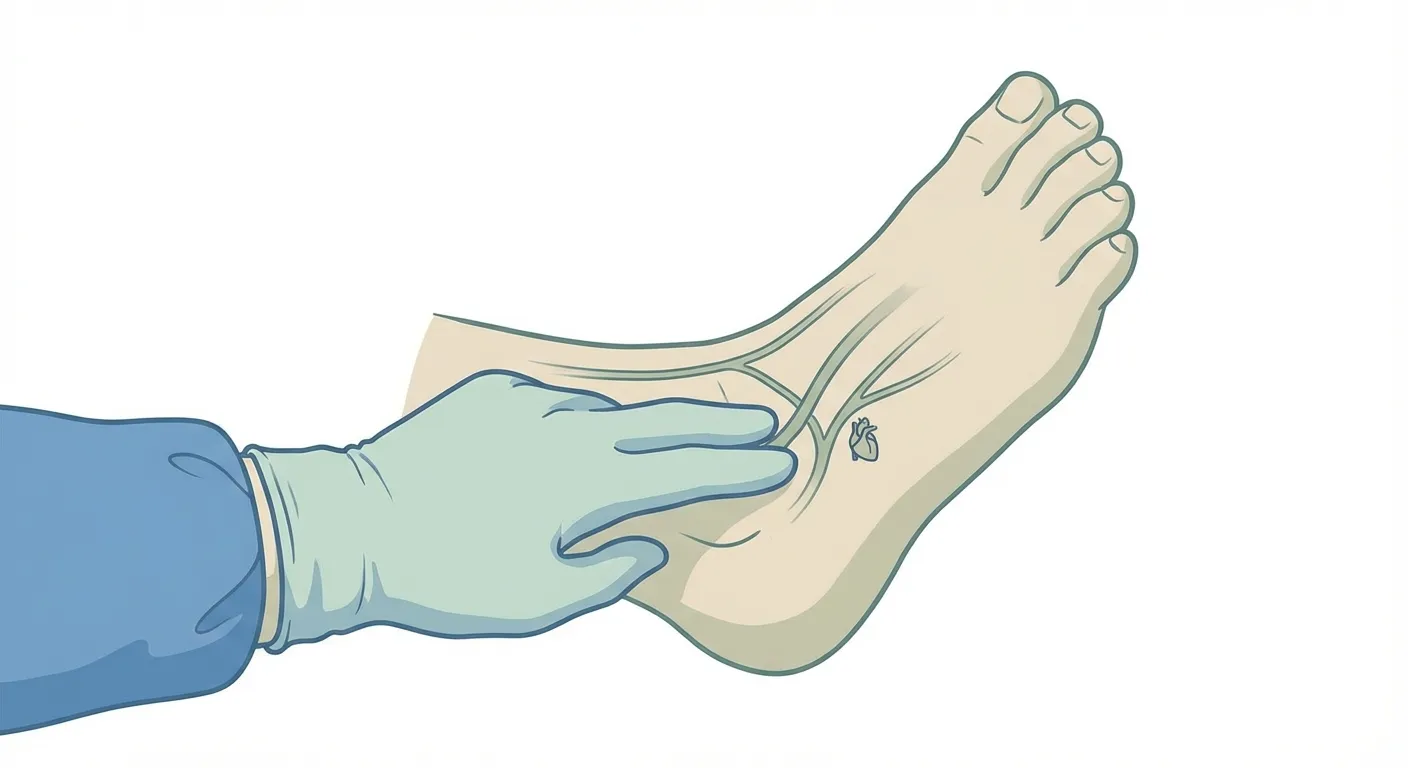
How To Assess Pedal Pulses And Where To Check Them
Learn about How To Assess Pedal Pulses And Where To Check Them at Vascular & Interventional Specialists. Expert vascular and interventional care across ...
Reviewed by VIS clinical team Last reviewed: May 2026
Quick answer: Pedal pulses are the pulses you can feel in the foot from the dorsalis pedis artery (on top of the foot, between the first and second toes) and the posterior tibial artery (behind the medial malleolus on the inside of the ankle). Use two fingers, not your thumb, with light pressure. Pulses are graded 0 to 4+, with 2+ being normal. A weak or absent pedal pulse is one of the earliest physical findings of peripheral artery disease (PAD).
In trauma assessment, finding and verifying a pedal pulse is necessary. These actions are performed before and after placing a lower extremity splint and the immobilization of the backboard for a long time. Patients on a backboard or in a lower extremity splint should have their pedal pulse checked as part of their continuous assessment.
A thorough review of the patient’s condition will determine the proper treatment plan for the patient. Read on to learn more about pedal pulses and how to assess them.
How To Assess Pedal Pulses
Anatomy of the Pedal Pulses
The dorsalis pedis artery is a blood vessel that transports oxygenated blood to the dorsal surface of the foot. The dorsalis pedis artery runs from the anterior aspect of the ankle joint to just before the proximal portion of the first intermetatarsal gap, which connects the big and second toes. This artery serves a vital role in assessing peripheral circulation, and a missing or weak pulse here is one of the earliest physical findings of peripheral artery disease (PAD) (NIH StatPearls — Peripheral Pulse).
Why Do We Need to Check For Pedal Pulses?
Here are some situations when an assessment of pedal pulse is required:
-
Trauma: Any trauma that causes a lower-limb injury requires this assessment. A circulation check should be performed before and after a splint is placed on a suspected fracture or after a hemorrhagic wound is bandaged.
-
Deficit complaints: If there are any complaints from patients of numbness or tingling in a limb, it might be beneficial to assess the circulation. The absence of a pedal pulse and symptoms of pain should be investigated further.
-
Incapacity to walk: Patients who cannot ambulate easily and comfortably or who experience pain in the limbs should get a circulation check.
Tips To Assess And Check Pedal Pulses
The dorsalis pedis artery can be challenging to locate. Paramedics typically use their index and middle fingers while evaluating pedal pulses. The thumb is avoided during a diagnosis since its own artery runs through the center, causing interference that can be mistaken for the patient’s pulse.
Compared to the carotid, which is bigger and closer to the heart, the pedal pulses do not require forceful pressure to identify. The harder you push, the more likely you will miss the pulses. The following guidelines may help when paramedics evaluate pedal pulses for patients:
-
Remove shoes, socks, tights, and anklets out of the way to expose the patient’s skin for easier assessment.
-
If the patient’s foot is not injured, reposition it to its usual anatomical position.
-
The dorsalis pedis pulse and the posterior tibial pulse, which are behind and below the medial malleolus, should be checked.
-
Since the skin may pulsate above the artery, it would help to visualize the dorsalis pedis. Lightly press two or more fingers against the skin if you can’t see anything. Start at the toes and work your way up to the leg until you feel the pulse.
-
Switch to the other leg if you cannot identify the pedal pulse. Locating where one pulse is could help you assess the other.
-
Once you’ve found a pedal pulse, mark the spot with a pen to make reassessment easy.
Frequently Asked Questions
What are pedal pulses?
Pedal pulses are the pulses you can feel in the foot from the dorsalis pedis and posterior tibial arteries. Both carry oxygenated blood to the foot. A missing or weak pedal pulse is one of the earliest physical findings of peripheral artery disease (PAD).
Where do you feel a pedal pulse?
There are two locations. The dorsalis pedis pulse is felt on the top of the foot, in the groove between the bases of the first and second toes. The posterior tibial pulse is felt behind and just below the medial malleolus, the bony bump on the inside of the ankle.
How do you check a pedal pulse?
Use your index and middle fingers, never the thumb (the thumb has its own pulse that can be confused with the patient’s). Press lightly. Pressing too hard occludes the artery and you will miss the pulse. Start at the toes and work your way up the foot until you feel the beat. If you cannot find the pulse on one side, switch to the other leg, find it there, then use the corresponding location on the side you are assessing.
How are pedal pulses graded?
Pedal pulses are graded on a 0 to 4+ scale. 0 means absent, no pulse felt. 1+ means barely palpable and weak. 2+ is the normal grade. 3+ means stronger than normal or increased. 4+ means bounding, very strong, often seen with high cardiac output or specific arterial pathology.
What does a 2+ pedal pulse mean?
A 2+ pedal pulse is the normal finding. It means the pulse is easily palpable, regular, and at the strength expected in a healthy adult. Documenting “2+ DP” or “2+ PT” in a chart confirms a normal physical exam at that artery.
What if I cannot feel a pedal pulse?
An absent or weak pedal pulse can indicate reduced arterial blood flow to the foot, most commonly from peripheral artery disease (PAD). Other causes include trauma, swelling, or anatomic variation. When a patient has new symptoms (leg pain when walking, numbness, color or temperature changes in the foot) along with an absent pulse, vascular evaluation is warranted. If PAD is suspected, schedule a consultation with a vascular specialist.
Is it normal to feel my own pulse in my foot at rest?
Feeling your own foot pulse can be normal, especially when the foot is elevated or right after exercise. A persistently strong, throbbing, or noticeable foot pulse, particularly with pain, swelling, or color changes, can sometimes signal vascular issues and is worth discussing with a doctor.
When should I see a vascular specialist about my pedal pulses?
See a vascular specialist if pedal pulses are absent or significantly weakened on one side, or if you have leg pain when walking that improves with rest (claudication), non-healing wounds on the foot, or color or temperature changes in the lower legs. Vascular & Interventional Specialists offers consultations across our locations.
If you have questions about pedal pulses or any conditions discussed here, we can help.
Vascular & Interventional Specialists offers screening, diagnosis, and treatment for a wide range of vascular conditions. We specialize in vascular surgery and interventional radiology – world class procedures right here in your world.
If you’re having trouble with any of these symptoms, you can reach us at 605-217-5617. We’re here to help.